
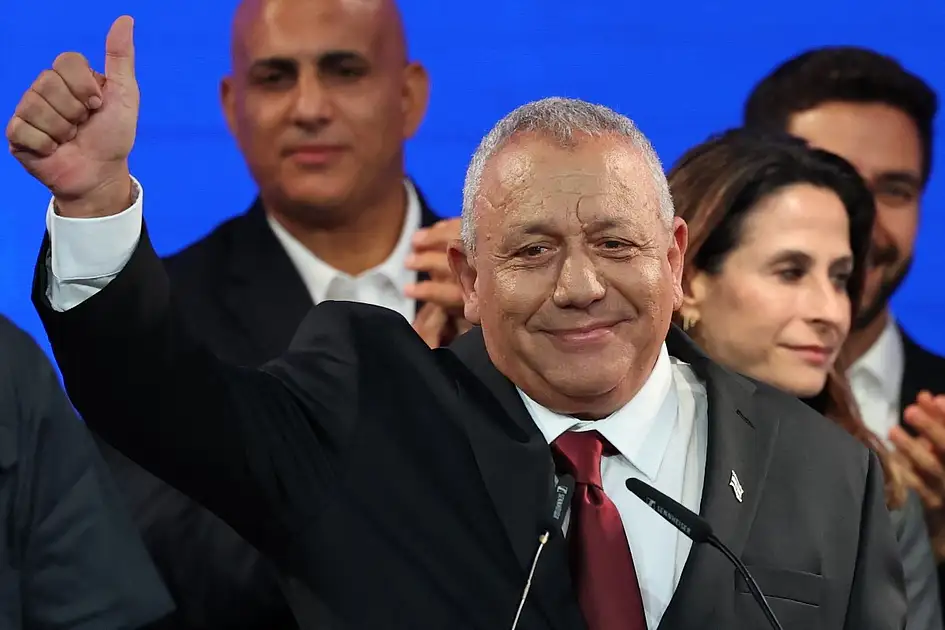
President Isaac Herzog named former IDF chief Gadi Eisenkot as the first candidate to try forming a government after the 27 October election left Israel without a clear majority. Eisenkot, the strongest challenger to long‑time prime minister Benjamin Netanyahu, will begin negotiations tomorrow.
Netanyahu’s religious‑nationalist bloc fell short of the 61 seats needed for a majority, securing only 53 of the 120‑seat Knesset. While Likud remained the largest single party with 27 seats, Eisenkot’s Yashar party came second with 21 seats, and a coalition of four centre‑left to right‑wing Jewish parties gathered 48 seats. Arab parties together won an unprecedented 19 seats.
Eisenkot has ruled out joining forces with Arab parties, even though their support would give him a parliamentary majority.
He now has 28 days, with a possible 14‑day extension, to assemble a governing coalition. Analysts outline three unlikely pathways: a minority government supported from outside by Arab parties, a partnership with ultra‑Orthodox parties previously shunned by Eisenkot, or a unity arrangement with Netanyahu.
If Eisenkot fails, another nominee can be given the mandate; a third failure would trigger a new election after roughly 100 days of deadlock.
The appointment marks a potential historic moment, as Eisenkot, the son of Moroccan immigrants, would be the first prime minister from Israel’s Mizrahi community, whose roots lie in the Middle East and North Africa.
A media‑shy figure, Eisenkot entered politics only in 2022 and briefly served in Netanyahu’s wartime cabinet after the October 7, 2023 Hamas attack before returning to opposition.
From the opposition benches, he has publicly criticized Netanyahu’s handling of the Gaza war and vowed never to sit in a government with him.
Eisenkot’s personal loss—his son and two nephews were killed fighting in Gaza—adds a poignant dimension to his security‑focused campaign, which highlighted his “Dahiyeh doctrine” of strong retaliation, a strategy he applied during the 2006 Lebanon war.
He has also spoken out against recent settler violence against Palestinians and opposes the far‑right coalition partners Itamar Ben‑Gvir and Bezalel Smotrich, both sanctioned by some Western nations for inciting violence.
With the deadline looming, the coming weeks will test whether Eisenkot can bridge deep political divides or whether Israel will head back to the polls.